
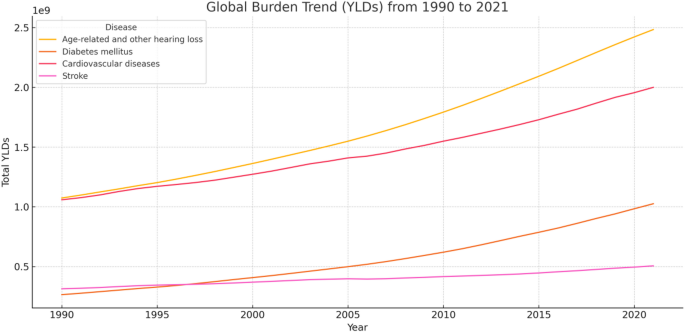
Global trends in YLDs
From 1990 to 2021, global YLDs for all four chronic conditions analyzed—age-related HL, diabetes mellitus, CVD, and stroke—increased substantially. HL YLDs rose from 28.7 million to 67.9 million (+ 136.7%), reflecting the mounting burden of sensory impairment associated with population aging. Diabetes exhibited the steepest growth, with YLDs increasing from 16.1 million to 66.4 million (+ 311.9%). Similarly, CVD YLDs rose from 23.7 million to 53.0 million (+ 123.8%), and stroke-related YLDs increased from 12.0 million to 25.6 million (+ 112.6%).
This growth was particularly pronounced in individuals aged 65 years and older, aligning with global aging patterns. Regionally, the burden of HL was highest in East Asia and Pacific, particularly in China, due to demographic scale and age structure. However, the highest age-standardized rates (ASRs) were observed in countries with larger elderly populations, such as those in Europe and North America.
For diabetes, the burden was disproportionately high in regions with younger populations, including Sub-Saharan Africa and South Asia. These disparities highlight the interplay of demographic and epidemiologic transitions across regions.
Figure 1 presents global trends in YLDs from 1990 to 2021 for the four conditions, showing consistent and substantial increases across all diseases, especially for diabetes and HL.

This line plot shows the global trend of HL and major chronic diseases (diabetes, CVD, stroke) from 1990 to 2021, measured by YLDs. HL demonstrates a consistent rise across the decades, underscoring its growing public health impact.
Multivariate regression analysis
Multivariate regression analysis was used to examine the relationship between HL and the selected chronic conditions. The regression models revealed the following:
Diabetes: A weak and non-significant association was observed between diabetes and HL (coefficient = 0.031, p = 0.675).
CVD: The relationship between CVD and HL was negative and statistically significant (coefficient = −1.374, p = 0.0016). This may reflect the influence of multicollinearity and unmeasured confounders.
Stroke: A significant positive association was found between stroke and HL (coefficient = 1.798, p = 0.0010).
These findings indicate that stroke is a key contributor to the burden of HL, while diabetes was not independently associated, and CVD showed a negative but unstable relationship.
Depression regression analysis
Regression models examining the relationship between HL and depressive disorders also revealed a significant positive association:
HL (YLDs): Coefficient (β) = 0.218, p < 0.001.
This indicates that for every increase of 10,000 YLDs from HL, depression YLDs increased by approximately 2,180, highlighting a strong relationship between HL and depression.
Correlation analysis
A Pearson correlation matrix was calculated to assess the relationships between HL and chronic diseases over time. The strongest associations were observed between HL and CVD (r = 0.72), diabetes (r = 0.68), and depression (r = 0.55), indicating that HL is closely linked with these conditions in long-term temporal trends.
Figure 2 compares the average HL burden (YLDs) across World Bank-defined regions. East Asia & Pacific and Europe & Central Asia report the highest burdens, likely linked to aging demographics and better diagnostic/reporting systems.

This bar chart compares the average HL burden (YLDs) across World Bank-defined regions. East Asia & Pacific and Europe & Central Asia report the highest burdens, likely linked to aging demographics and better diagnostic/reporting systems.
Regional and gender differences
Significant regional differences were observed in the burden of HL. East Asia & Pacific, particularly China, had the highest absolute burden of HL. However, age-standardized rates were highest in regions with larger aging populations, including parts of Europe and North America.
Gender differences were also observed in the burden of HL. Women, particularly those aged 65 and older, reported significantly higher YLDs for HL and depression compared to men (10.48 M vs. 9.06 M in 2021). This aligns with previous findings, which suggest that older women are more vulnerable to both HL and associated mental health issues.
Figure 3 illustrates the average HL burden in China, the United States, and India, with China showing the highest burden.

This bar chart illustrates the average HL burden in China, the United States, and India. The United States displays the highest burden, with China and India showing growing trends influenced by demographic transitions.
Forecasting of future trends
Using the linear trend extrapolation model, we projected the global burden of HL YLDs to 2030. The forecast predicts an additional increase of 18.3% in YLDs from HL, reaching an estimated 75.6 million by 2030. This projection underscores the growing global health challenge posed by HL, particularly in aging populations.
Figure 4 highlights the distribution of YLDs for HL across different age groups and by gender. The burden intensifies with age, and women tend to report slightly higher median values, especially in older age brackets.

This boxplot highlights the distribution of YLDs for HL across different age groups and by gender. The burden intensifies with age, and women tend to report slightly higher median values, especially in older age brackets.
Additional correlation visualization
To further illustrate the associations between HL and chronic diseases, we constructed a Pearson correlation heatmap across world regions for 2021 (age ≥ 45 years). Figure 5 shows that HL was moderately positively correlated with stroke (r = 0.54), moderately negatively correlated with diabetes (r = −0.58), and weakly negatively correlated with CVD (r = −0.16). These findings suggest that, on a regional scale, HL aligns more closely with stroke burden, while its distribution diverges from that of diabetes and CVD.

Pearson correlation heatmap of YLDs for HL, diabetes, CVD, and stroke across world regions in 2021 (age ≥ 45 years). Correlation coefficients are based on aggregated regional YLDs. HL shows a moderate positive correlation with stroke, but weaker or negative correlations with diabetes and CVD.
link